
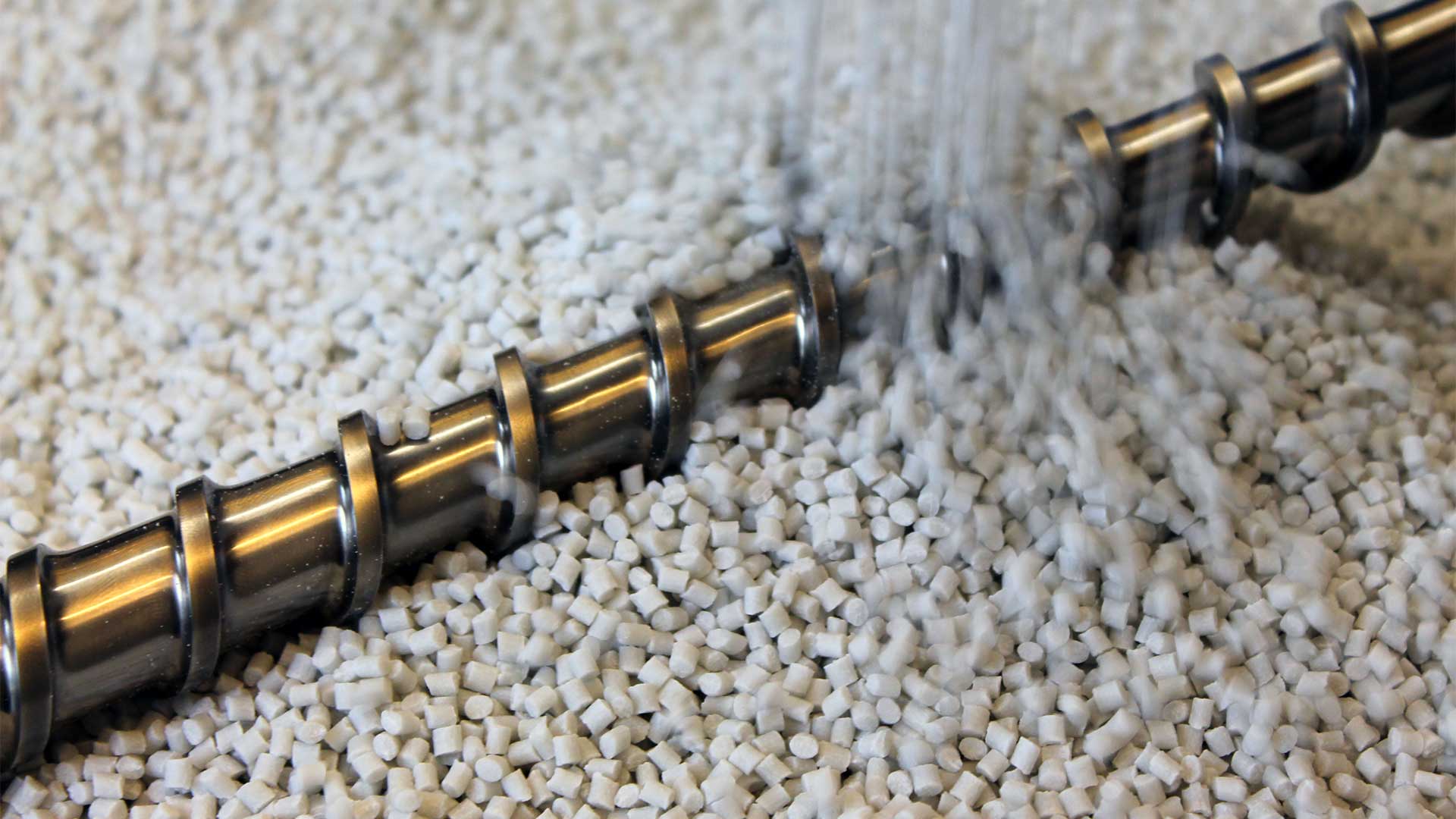


Guide to purging: Understand its importance in preventing contamination and optimising machinery performance in manufacturing.
Purging, or cleaning out traces of raw material within machinery, is a crucial step that can contribute to business profitability and sustainability.
Perhaps your organization currently uses a purging compound. Or maybe you don’t use a purging compound and simply continue processing products until it clears out any contamination.
In either scenario, this guide will give you a clearer understanding of what purging is, what types of manufacturing processes are a good candidate for purging, the benefits, and the purging process.
What is purging?
Purging is a process that involves running a cleaning agent through thermoplastic processing machinery in order to clear out any remaining raw material or colourant. By removing buildup within the machinery, purging helps prevent contamination of products, cuts down on waste, and helps the machinery run optimally.
Here’s how purging works:
In the process of creating products, raw materials will passively build up in the machine. Buildup slows down the process as it takes more time to heat the material. It can also create black or discoloured specks that blemish the products, which means those products have to be discarded as waste.
For manufacturers who produce multiple products on the same machinery, the transition between raw materials can cause contamination. For example, if transitioning between blue- and yellow-coloured materials, if the machinery is not cleaned between colours, it will produce some products that mix the colours or appear green. This unusable product is waste.
By cleaning the machinery with a purging compound, manufacturers reduce contamination, in turn reducing the amount of waste.
What makes a product or process a good candidate for purging?
Purging is an important step for many types of thermoplastic manufacturing processes, including injection moulding, extrusion and film lines.
Injection moulding is a manufacturing process that involves heating and melting raw material pellets, injecting it into a mould cavity, and solidifying the material into a final product. It is often used to produce high volumes of items like TV parts, car doors, small toys, singular larger pieces, and home appliance parts.
Extrusion is a process in which material is pushed with force through an opening or die to create a specific shape. (Imagine pushing play-doh through a long tube to produce a thin rope.) It is often used to produce window siding, pipes, and tubes.
Extrusion blow moulding is a process in which a heated plastic tube, called a preform or parison, is placed into a closed mould and then filled with air to create one-piece, hollow products. (Picture something similar to glass blowing.) It is often used to produce bottles, jugs, and other containers.
Blown film is a process in which material comes out of a circular die and air is pumped in the middle of it to make a tall bubble. As it expands out of the die, the bubble cools and solidifies before it moves through a set of rollers to create a thin sheet. The bubble can consist of different layers—from 1 to 11 in total—each of which come from a separate extruder. This process is used for many applications including plastic bags, lidding films for food packaging, and food or medical pouches.
Due to the range of colours and polymers used, injection moulding accounts for 70+% of applications that employ a purging compound.
Instances for which purging is beneficial
- Colour change: When transitioning between production of two different coloured products, purging reduces the amount of colour transfer or mixing. This is especially important when transitioning from a dark colour to a light colour . Without purging, remnants of the darker colour will bleed into the lighter colour products, wasting production time and causing those blemished products to be discarded as waste.
- Polymer change: In this instance, the process uses the same machine but switches the type of polymer between runs. This change may mean the viscosity is different or the formulation of the resin is different, perhaps including various additives like flame retardants or UV stabilizers. Because of these changes, the previous resin cannot be fully flushed out of the machine by the next resin. Without purging between the different polymers, remnants of the first type will mix into the second type, contaminating the product and producing waste.
- Maintenance of machinery: Even if a manufacturer consistently uses the same machine and material, purging helps maintain the machine and remove buildup that occurs over time, especially in areas of lower flow in extruders, or at the check ring and back of the flights of the screw in injection molding. This allows the machinery to work at its optimal level and reduces contamination from build-up, black spots, and old carbonisation.
What are the benefits of purging?
Purging has a number of benefits:
- Waste reduction: While it depends on the current product and process, incorporating a purging compound can generate an average 50% reduction in scrap waste. This decrease in waste production contributes to overall sustainability.
- Cost savings: When using a purging compound to clean the machinery, rather than continually processing raw materials, companies reduce the amount of raw materials that would be wasted in the transition process. By using a small amount of purging compound, rather than a large amount of raw materials, a manufacturer will realize an overall cost savings.
- Time savings: Purging decreases the time spent running machines to produce unusable products, which would require less labor overall and decrease operational costs.
- Opportunity for increased production: It’s also important to consider the opportunity cost. When you’re producing products that are discarded as waste, that is valuable time when your machinery could be producing sellable products and generating more revenue.
While there is an expense associated with purchasing a purging compound and an opportunity cost associated with downtime for the cleaning process, the listed benefits can ultimately outweigh these costs.
Did you know you could save as much as 75% or more in reduced down time, waste, and rejects by using a purging compound? That could translate to tens or hundreds of thousands of dollars.
Continue reading to learn more about purging in action and IMCD's Asaclean offering.
Do you want to read the full article?
Full access also means:
